Herniated Disc with Nerve Compression: What to Avoid, and How Physiotherapy Helps
Back pain radiating down the leg, numbness in the toes — these can be signs of a herniated disc pressing on a nerve. Here's what to strictly avoid, and how physiotherapy can help without surgery.
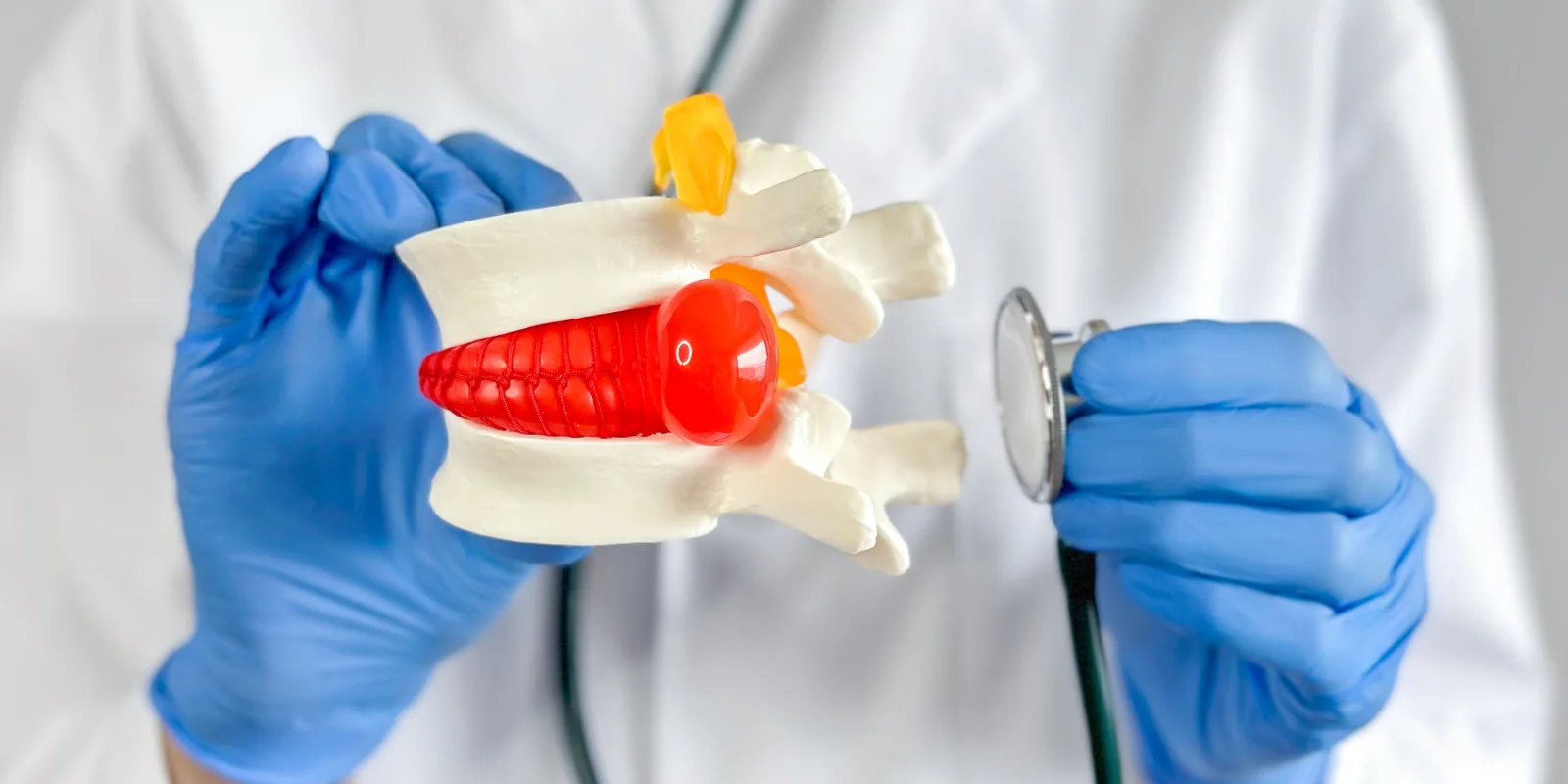
A herniated (slipped) disc happens when the spinal disc bulges or ruptures and presses on a nerve, causing back pain that radiates down the leg, numbness, or weakness. Many people aren't sure what they can still do, and what to avoid so the condition doesn't get worse.
Avoid movements that load the disc further — bending forward to lift heavy objects, sitting hunched forward for long periods, or twisting your torso forcefully. Physiotherapy plays a major role in non-surgical management: reducing pain, easing nerve compression, and preventing recurrence.
What to Avoid
Positions and Activities to Steer Clear Of
• Bending forward to lift heavy objects — always bend at the knees and keep your back straight when lifting
• Sitting hunched forward for long periods — looking down at your phone, or slouching at a desk — directly increases pressure on the disc
• Traditional sit-ups/crunches — repeated forward flexion loads the front of the disc repeatedly
• Lifting while twisting your torso — a movement pattern strongly associated with further disc herniation
• Prolonged bed rest — weakens the muscles supporting your back, which actually slows long-term recovery
• High-impact or twisting sports during an acute flare-up — running, jumping, golf, tennis — hold off until symptoms improve and your physiotherapist clears you
How Physiotherapy Helps
A 2025 meta-analysis pooling 43 studies found that all three conservative treatment modalities — exercise therapy, manipulation, and traction — produced significant reductions in pain and disability in patients with lumbar disc herniation.[1]
McKenzie Method (Directional Preference Exercise)
A technique using specific repeated movements (often extension-based) aimed at "centralizing" the radiating pain — moving it back toward the spine's midline, a sign that nerve compression is easing.
Nerve Gliding / Neural Mobilization
Exercises that help the nerve glide more freely through the space it passes through, reducing adhesion between the nerve and surrounding tissue.
Core Stabilization Exercise
Strengthens the core muscles that support the spine, reducing pressure on the disc over the long term.
Manual Therapy and Patient Education
Physiotherapists apply careful joint mobilization based on assessment findings, along with education on posture and proper lifting mechanics to prevent recurrence long-term.
Warning Signs That Need Emergency Care — Not Just Physiotherapy
• Numbness around the buttocks, anus, or genitals (saddle anesthesia)
• Loss of bladder or bowel control, or not noticing you've passed urine or stool
• Severe, rapidly worsening weakness in both legs
These symptoms may indicate cauda equina syndrome, a medical emergency requiring urgent surgery to prevent permanent damage. If you experience any of these, go to a hospital immediately — don't wait to book a physiotherapy appointment.
Quick Summary
| Symptoms | Guidelines |
|---|---|
| Radiating back pain down the leg with no warning signs | Physiotherapy + avoid positions listed above |
| Numbness and weakness in one leg | Physiotherapy with close symptom monitoring |
| Numbness in buttock region, loss of bladder/bowel control | Go to emergency room immediately |
| No improvement in symptoms after physiotherapy in 4–6 weeks | See physician for further evaluation |
LantavaFix Physiotherapy Clinic Koh Lanta
We thoroughly assess herniated disc and nerve compression symptoms, design personalized physiotherapy programs, and will immediately notify you if we find any signs requiring physician referral
References
- [1] Thavarajasingam, S. G., Ramsay, D. S. C., Namireddy, S. R., Kamath, A. G., Kanakala, S., Zaidi, H., Parikh, R., Peerbhai, A., Subbiah Ponniah, H., Arif, A., Salih, A., Thavarajasingam, A., Neuhoff, J., Scurtu, D., Jankovic, D., Kramer, A., & Ringel, F. (2025). Exercise, manipulation and traction physiotherapy in the conservative management of lumbar disc herniation: A systematic review and meta-analysis. Brain and Spine. https://doi.org/10.1016/j.bas.2025.105632
This article is written for general information purposes only and is not a medical diagnosis. If you experience symptoms indicated in the warning signs section, you should see a doctor immediately.