LantavaFix Clinic
Ultrasound Therapy
The role of Ultrasound Therapy (US) in modern rehabilitation. Expedite healing and improve pain and function associated with inflammatory conditions.
Book Now
Clinical Application
Ultrasound therapy is highly effective at expediting the healing process and improving pain and function. It is particularly indicated for managing complex inflammatory conditions in specific tissue types.
Primary Indications
- Tendinopathies
- Ligament Sprains
- Osteoarthritis
Mechanisms of Action
Ultrasound machines conduct an electrical signal through crystals found in the head of the ultrasound probe. The crystals vibrate and create mechanical waves at frequencies outside the range of human hearing (20 Hz – 20,000 Hz). This phenomenon is known as the "piezoelectric effect."
Thermal Effects
As the energy within the sound wave is passed to the material, it will cause oscillation of the particles of that material. Any increase in molecular vibration in the tissue can result in heat generation, and ultrasound can be used to produce thermal changes in the tissues.
Non-Thermal Effects
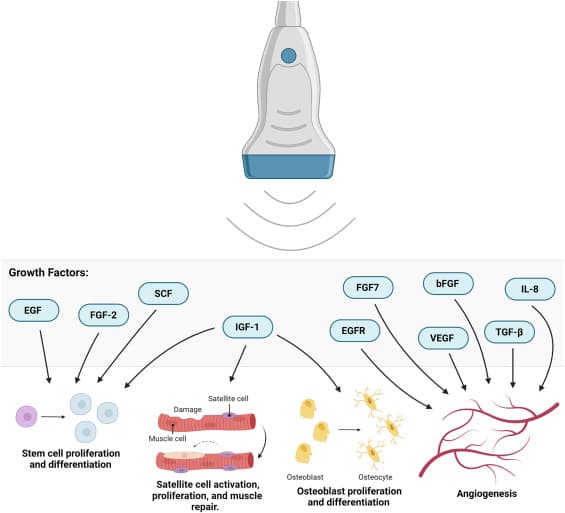
The non-thermal effects of US are attributed primarily to a combination of CAVITATION and ACOUSTIC STREAMING.
The result of the combined effects of stable cavitation and acoustic streaming is that the cell membrane becomes "excited" (up-regulated), thus increasing the activity levels of the whole cell. The US energy acts as a trigger for this process, but it is the increased cellular activity which is responsible for the therapeutic benefits.
Absorption Characteristics
Increasing Protein Content = Increasing Absorption.
Therapeutic effects are best achieved in high-protein, high-collagen tissues. The more vascular the tissue (e.g., muscle), the more energy is lost through blood flow, making the treatment less effective in those areas.
Optimal Absorption Tissues:
Tendon, Ligament, Fascia, Joint Capsule, and Scar Tissue.
Device Benefits
Intelligent Coupling Detection
Advanced modern systems include coupling detection settings. This technology provides the option to alert the clinician when the applicator has become decoupled from the patient's skin.
Ensures the patient is constantly receiving the intended, precise energy dosage for their specific treatment protocol without silent interruptions.
Frequently Asked Questions
Yes, it is a safe procedure. US can produce a mild heating effect so if left stationary for long periods this may result in skin burns. This is negated by continuously moving the treatment head.
The therapeutic effects are best achieved in high-protein, high-collagen tissue. The more vascular the tissue (e.g., muscle), the more energy will be lost through blood flow, so the treatment will not be as effective.
For acute conditions, US therapy using a low dose should be administered daily for at least the first five days. For chronic conditions, a higher dose can be administered less often. The total number of sessions will be determined by the pathology and presentation.
Therapeutic US should be considered as an inflammatory optimiser, so used in combination with pro-inflammatory interventions (e.g., Shockwave therapy, dry needling, injection therapy) it may enhance clinical outcomes.
Scientific References
Ready to Start Your Treatment?
Book your Ultrasound therapy session with our professional physiotherapists today.